The Ultimate LinkedIn Posting Guide for 2026
What's Changed, What Works, and What to Do About It
Updated June 2026 with new Q1 2026 algorithm data.
I've been using LinkedIn since I moved to the UK in 2010. It's been my networking backbone, my learning platform, and the source of more business conversions than I can count. It connected me with people I'd never have met otherwise, taught me things about my industry I didn't know I needed to learn, and opened doors that cold calling never could. But something has shifted. Posts that once reached thousands are now reaching hundreds - and if you've noticed the same thing, you're not imagining it.
LinkedIn has fundamentally changed how it decides who sees your content. The reach has dropped. The rules are different. And most B2B companies - particularly in engineering and technical sectors - haven't adjusted their approach. This article breaks down exactly what's happened, what the research says is working now, and gives you a practical playbook for both personal profiles and company pages in 2026.
Engineered Takeaways - In Plain English
Before we get into the detail, here's what you need to know right now:
- Your LinkedIn reach has probably dropped by around 50%. That's normal. It's happened to almost everyone.
- The algorithm has shifted from counting followers and likes to reading your content and deciding if it's genuinely relevant to the people seeing it.
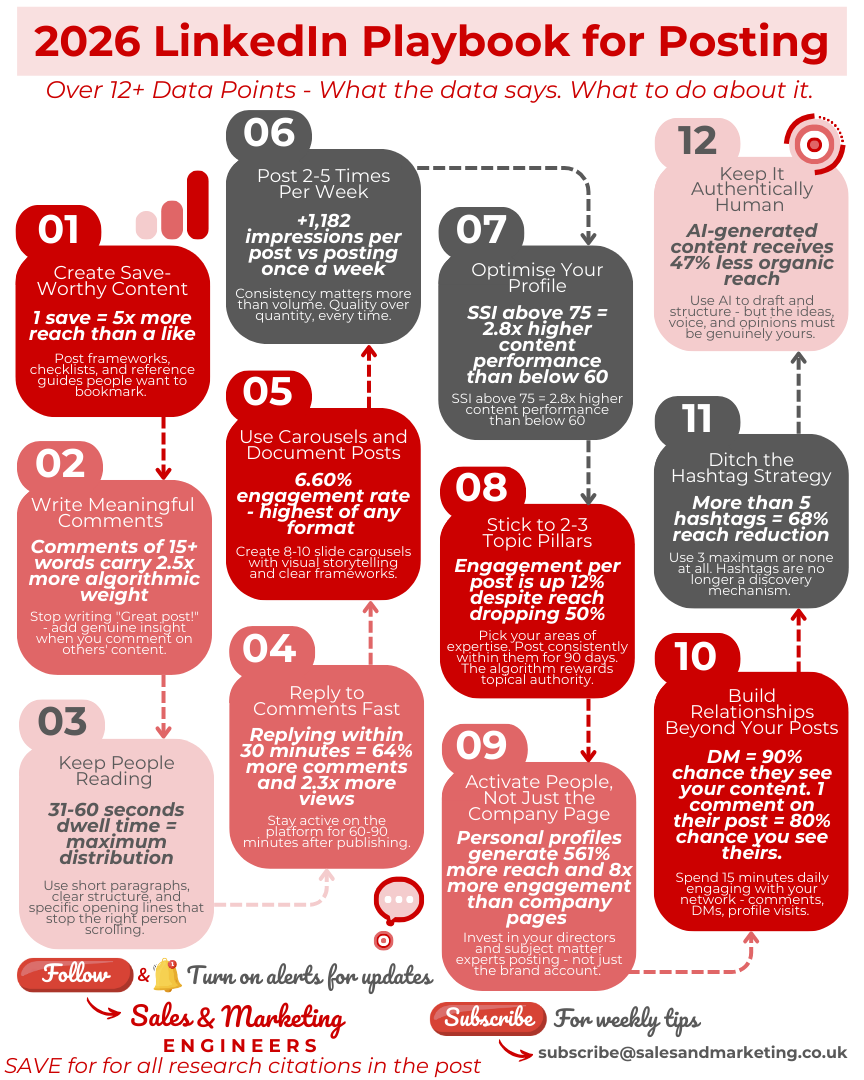
- Saves are now the most valuable engagement signal - roughly 5 times more powerful than a like.
- Personal profiles outperform company pages by over 500% in reach. People trust people, not logos.
- Company page organic content now makes up just 1-2% of the LinkedIn feed. Down from 7% in 2021.
- Carousels, frameworks, and document posts are the top-performing formats.
- LinkedIn is still the most powerful B2B platform on the planet - 80% of all B2B social leads come from it.
- This is no longer just a marketing task. Subject matter experts, directors, and team leaders need to be the ones posting.
- Posting 2-5 times per week is the sweet spot. Quality over quantity, every time.
Quick Links
- The Paradox: More Powerful Than Ever, Less Reach Than Before
- What Actually Changed - The Algorithm Shift in Plain English
- What LinkedIn Rewards Now - The New Engagement Hierarchy
- Which Formats Get the Best Reach
- Personal Profiles - What the Data Says and What to Do
- Company Pages - The Structural Problem and How to Respond
- Beyond Posts - Sales Navigator, Newsletters, and Going Live
- The Playbook - This Isn't Marketing's Job Anymore
- Closing Summary - Strategy First, as Always
- Frequently Asked Questions
The Paradox: More Powerful Than Ever, Less Reach Than Before
Here's the contradiction that catches most people off guard.
LinkedIn is said to generates most of all B2B leads from social media, outperforming Facebook, X, and Instagram combined. Research found LinkedIn to be 277% more effective for B2B lead generation than Facebook and Twitter LinkedIn ads deliver conversion rates up to 2 times higher than other platforms and a 28% lower cost-per-lead compared to Google AdWords 40% of B2B marketers say it's the most effective channel for generating high-quality leads, and 85% claim it delivers the best value among all social media platforms. 89% of B2B marketers use LinkedIn for lead generation, and 62% say it produces leads for them effectively.
And yet, organic reach has dropped by approximately 50% year-over-year for the vast majority of users. AuthoredUp's tracking of over 621,000 posts found that 98% of users experienced a reach decline. Median impressions fell from 1,211 per post in June 2024 to 636 per post by May 2025 - a 47% drop.
The most recent data shows the freefall has become a plateau. Saywhat's Q1 2026 analysis of nearly 400,000 posts found median impressions down 68% from the Q3 2023 peak, but down just 2% between Q4 2025 and Q1 2026 - the decline has largely stabilised. The same dataset reveals just how concentrated reach has become: the top 1% of posts achieve 124 times the reach of the median post, and for average creators the bottom 80% of posts generate just 11% of their total impressions. The game is no longer about posting consistently and hoping - it's about understanding why your best posts work and doing more of that.
So the platform is more valuable than ever for B2B - but fewer people are seeing your content. That sounds like a problem. It is a problem if you don't understand why. But once you do, it's actually an opportunity.
The reason is simple: LinkedIn changed how its algorithm works. And that change favours the kind of content most B2B companies should have been creating all along.
What Actually Changed - The Algorithm Shift in Plain English
LinkedIn's algorithm has evolved through three distinct phases. First, it was follower-driven - the more connections you had, the more people saw your posts. Then it shifted to engagement-driven - posts that got quick reactions got pushed further. Now, it's moved to something fundamentally different: relevance-driven distribution.
The technical name behind this shift is 360Brew. It's a 150-billion-parameter AI model developed by LinkedIn's Foundation AI Technologies team, described in a research paper published in January 2025. The paper was later withdrawn for licensing reasons, not quality concerns, and LinkedIn hasn't officially confirmed full deployment. But the direction of travel is well documented and the effects are visible everywhere.
In March 2026, LinkedIn's own Engineering blog removed any remaining doubt, publicly describing a new feed ranking system powered by large language models that understands what a post is actually about and matches it to each member's evolving interests and career goals. The speculation phase is over - relevance-driven distribution is now confirmed, in LinkedIn's own words.
Here's what matters in practical terms. The old algorithm tracked metadata - clicks, hashtags, connection graphs, post timestamps. The new system reads your content semantically. It understands what your post is actually about. It cross-references your post content against your profile - your headline, your About section, your experience history - to evaluate whether you have genuine expertise in what you're talking about. It analyses the viewer's recent engagement history to generate personalised relevance scores. And it evaluates whether comments on your posts are substantive or performative.
That last point is important. It's not just counting engagement anymore. It's assessing the quality of that engagement.
It's also worth noting that this isn't about followers being irrelevant. They still matter - but in context. A well-connected profile with genuine relationships in a defined niche will outperform a larger, more scattered network. The algorithm rewards relationship density, not audience size.
What LinkedIn Rewards Now - The New Engagement Hierarchy
The engagement signals that drive distribution have been completely reshuffled. Based on converging data from Richard van der Blom's Algorithm InSights 2025 report analysing 1.8 million posts across 60+ countries, AuthoredUp's analysis of 3 million+ posts, and multiple practitioner studies, here's what now carries the most weight:
Saves
This is the single most powerful signal. One save drives approximately 5 times more reach than a like and 2 times more than a comment. A save tells the algorithm this content has lasting reference value - exactly what the new system is designed to reward.
Meaningful comments
Comments of 15 words or more carry 2.5 times more algorithmic weight than short ones. Generic comments like "Great post!" are now classified as engagement noise and may actually be penalised. The algorithm can distinguish between a genuine response and a performative one.
And the volume of conversation you create matters as much as the comments you receive. Q1 2026 data found the top 1% of creators reply to comments 255% more than average - 134 replies per week against 38 - with a meaningful correlation (0.412) between commenting activity and follower growth. Replying isn't admin. It's distribution.
Dwell time
How long someone actually reads or watches your content matters enormously. Posts generating 31-60 seconds of dwell time achieve maximum distribution. This is the silent multiplier - you can't see it in your analytics, but it's one of the most powerful signals driving your reach.
Relationship signals
This is where it gets interesting for anyone serious about networking. Commenting once on someone's post creates an 80% chance you'll see their next post. Sending a DM creates a 90% chance they'll appear in your feed. Visiting someone's profile boosts their visibility to you by 60%. And if an author responds to comments within the first 30 minutes, that post receives 64% more total comments and 2.3 times more views.
What gets penalised
Engagement bait, engagement pods (now detected algorithmically), hashtag stuffing, mass tagging of more than 10 people, and AI-generated formulaic content. That last one is significant - Brixon Group's data from over 500 B2B profiles found AI-generated content receives 47% less organic reach. On hashtags, the bar has dropped even further: earlier research showed more than 5 triggered a 68% reach reduction, but Q1 2026 data found posts with more than 3 hashtags performed 71% worse than posts with none at all. Hashtags have gone from being a primary discovery mechanism to having minimal impact.
One more for the penalty list: generic questions bolted onto the end of posts now reduce reach rather than lifting it - posts ending with a question achieved a median of 853 impressions against 1,140 without. Ask a question only if you genuinely want the answer.
The message is clear. Create content people want to save. Write things that make people stop scrolling and actually read. And engage genuinely - both on your own posts and on other people's.
Which Formats Get the Best Reach
Not all content formats perform equally under the new algorithm. Here's what the data shows from van der Blom's 2025 report and Socialinsider's analysis of 1 million posts:
Documents and carousels
These remain a powerhouse format - but the crown is slipping. Multi-image document posts drive a 6.60% engagement rate - the highest of any format. The best-performing documents have 8-10 slides with clear visual storytelling and generate 15-20 seconds of dwell time. The reach multiplier sits at 1.45 times average. However, Q1 2026 data shows carousel reach declining quarter on quarter, while infographics have become the single most common format among top 1% posts at 28.6%. Both still achieve roughly 3 times the reach of text-only posts, so the lesson isn't to abandon carousels - it's that a well-designed infographic is now the strongest visual play on the platform.
Frameworks and how-to posts
Posts that present a clear process, a step-by-step method, or a structured framework consistently outperform opinion pieces without structure. This makes sense under a save-driven algorithm - people bookmark save things they can refer back to, representing one of the highest multiplier in organic reach. A carousel that walks through your five-step approach to solving a specific problem is exactly the kind of content this algorithm was designed to surface.
Polls
Highest reach multiplier at 1.64 times, yet they represent only 1.4% of all content on the platform. That's a significant untapped opportunity. Use them strategically, not as throwaway engagement bait.
Short vertical video
Video usage surged 69% year-over-year, but here's the catch - video reach actually declined 35-72% because completion rates are typically low. The algorithm penalises content people don't finish. Short vertical video (30-90 seconds) with captions is the exception - vertical video reach increased 80%, while horizontal video reach declined 18%.
Worth noting - the data is now split on orientation. Saywhat's Q1 2026 analysis found horizontal video performing 18% better than vertical, possibly because vertical video still feels out of place on a platform people browse at work. But my own feed tells a different story - LinkedIn has been placing short vertical videos in the first few posts of my feed for the last few weeks, which suggests the platform is actively pushing the format. When the studies disagree and the platform is visibly experimenting, the answer is to test. I'd experiment with short vertical video alongside your other formats and let your own analytics make the call.
Multi Image Posts
These have also been reported by a large study to have more engagement each year, as it increases dwell time as the scroller is wanting to see all the images posted. Whatever the image format, default to portrait at a 4:5 ratio (1200x1500 pixels) - portrait images perform 47% better than landscape simply because they take up more feed space.
Structure and readability
How you lay a post out is now measurably part of its performance. Posts with fewer than 7 paragraphs performed 66% worse than posts with more than 14, and posts using words averaging more than 5 letters performed 40% worse. Long posts win - but only when they're broken into short, skimmable paragraphs written in plain English. Write like you talk, then add more line breaks than feels natural.
Newsletters and articles
Reach climbed nearly 48% for these formats. The algorithm favours authority-driven long-form content. If you have genuine expertise to share, a newsletter is a strong strategic play and subscribers get notified on the platform as well as an email to their inbox by default.
Text-only posts
The weakest format. Usage down 41%, engagement down 18%. A text-only post with no visual element is fighting an uphill battle.
Unique points of view
It has also been shown that
posts with unconventional or unique points of view can get 165% more organic reach too - so doing your homework and coming up with personal and different view points can benefit your posts.
Links
Too many spammy links flags the algorithm but links that help the post and give readers more information is good and
helps boost reach. The most recent data is emphatic on this: posts with 1-3 genuinely useful links achieved 43% higher reach, and posts with
more than 3 achieved 441% higher reach. The old "never link" advice is officially dead - as long as the links add real value.
Personal Profiles - What the Data Says and What to Do
Here's the good news hidden inside the reach decline: while raw views are down approximately 50%, engagement per post is actually up 12%. Fewer people are seeing each post, but those who do are more relevant to the content and engage more meaningfully.
That's not a bug. That's the whole point of the algorithm change. LinkedIn is showing your content to people who actually care about your topic rather than blasting it across your entire follower base.
Your profile is now a ranking signal
This is perhaps the most important tactical shift to understand. The algorithm cross-references your post content against your profile headline, About section, and experience. If it can't categorise your expertise, it can't distribute your content properly. Profiles with a Social Selling Index above 75 achieve 2.8 times higher content performance than those below 60 - and that correlation has strengthened 37% since 2023.
Your profile isn't just a digital CV anymore. It's an active input to the algorithm that determines whether your posts get seen.
Choose 2-3 topic pillars and stay inside them
The algorithm needs to know what you're about. If you post about manufacturing processes on Monday, dog training on Wednesday, and cryptocurrency on Friday, the system can't build a coherent picture of your expertise. Pick 2-3 areas that align with your professional positioning and commit to them for at least 90 days.
For a B2B professional in engineering or technical services, that might look like: your domain expertise (the specific problems you solve), your approach or methodology (how you solve them), and proof or case work (results and lessons learned).
This is a social network - not a broadcast channel
I've said this for years and the data now backs it up completely. LinkedIn is a networking tool. People want to hear your personal views on things. They want to see your face. They want to understand your career journey and how it connects to the expertise you're sharing.
Posts with personal experience, your own photographs, and genuine opinion consistently get more reach than corporate-sounding content pushed out as promotional material. That doesn't mean every post needs to be deeply personal - but it does mean your voice, your perspective, and your human experience should come through in everything you share.
The algorithm is designed to reward authenticity. Use it.
Connections matter - but not in the way you might think
Reach decline varies by account size. Accounts under 5,000 followers experienced the steepest drop at 78%. The sweet spot sits around 15,000-25,000 followers, where reach dropped only 43%. Larger accounts with 50,000+ followers saw a 62% decline.
But here's what I've observed personally working on client accounts: I've seen directors with a few hundred connections get more reach and engagement than people with several thousand. The quality of posts and the engagement beyond those posts - commenting on other people's content, building genuine relationships, having real conversations - are enormously powerful. There's quite a lot of movement around reach at any particular follower level. A smaller, highly engaged network built around your genuine professional community will outperform a large, passive audience every time.
Company Pages - The Structural Problem and How to Respond
This is where the data gets uncomfortable.
Organic company page content now represents just 1-2% of the LinkedIn feed, down from 7% in 2021. Company page posts reach approximately 1.6% of followers - a 15% decline from late 2023. The overall organic reach decline for company pages sits at 60-66% from 2024 to early 2026, significantly steeper than the 50% decline for personal profiles.
One study shows that personal profiles generate 561% more reach and 8 times more engagement than company pages sharing identical content. The Refine Labs study found that employee posts generated 2.75 times more impressions and 5 times more engagement than the company page, despite employees having 46% fewer followers . And 92% of B2B buyers trust employee recommendations over traditional advertising. Yet another study of over 150k posts and $million impressions shows it’s more like 14x times more engagement.
Van der Blom's feed composition analysis tells the full story. In 2022, organic company content made up 7% of the feed and top creator content was 15%. By 2025, organic company content had shrunk to 2% while top creator content had grown to 31%. LinkedIn ads account for 11% and promoted company content takes up 28%.
LinkedIn is engineering a pay-to-play model for company visibility. That's the reality.
What to do about it
Stop treating your company page as your primary distribution channel. It's not. It's now your credibility anchor - your shop window, not your megaphone.
Your company page still matters for brand legitimacy, recruiting content, major announcements, and as a platform for paid amplification through Thought Leader Ads (which promote personal profile posts with paid targeting). When you do post organically, prioritise carousel and document posts - they maintain the strongest performance on company pages. Text-only posts are effectively dead on company pages with a 0.42 times reach multiplier.
The real distribution engine for your company is now the people within it. Invest your content creation energy into the personal profiles of your directors, subject matter experts, and team leads. That's where the reach is. That's where the trust is. And that's where the conversions happen.
Beyond Posts - Sales Navigator, Newsletters, and Going Live
LinkedIn is not only about posting and commenting. There are several other features that, when used strategically, turn the platform into a complete B2B growth system.
Sales Navigator
This is where inbound and outbound come together on one platform. Your team can use Sales Navigator to identify and connect with your exact target audience - by industry, company size, job title, geography, and buying signals. Once those connections are made, your content appears in their feed naturally. The outbound prospecting builds the network. The inbound content builds the trust. Combined, they create a pipeline that neither approach achieves alone.
Newsletters
Newsletter reach climbed nearly 48% under the new algorithm. When someone subscribes to your newsletter, they get a notification every time you publish. That's a direct line to your audience that doesn't depend on the algorithm at all. For B2B professionals with genuine expertise to share, a regular newsletter is one of the most reliable distribution channels available on the platform.
LinkedIn Live and events
Going live on LinkedIn creates real-time engagement that the algorithm rewards. Live sessions also serve as content that can be repurposed into shorter posts, carousels, and clips. LinkedIn Events allow you to promote, host, and follow up with attendees - turning a single session into a full engagement cycle.
Connections as engagement, not just broadcasting
Every connection request, every DM, every profile visit is a relationship signal that feeds into the algorithm. Connecting is not just about growing a number. It's about building a network of people who are genuinely relevant to your business - and who will see, engage with, and respond to your content over time.
We'll go deeper into each of these in a future blog - how to build a complete LinkedIn system that combines content, outreach, and relationship-building into one coordinated approach. But the key point here is this: if you're only thinking about posts, you're only using a fraction of what LinkedIn offers.
The Playbook - This Isn't Marketing's Job Anymore
Here's the shift most companies haven't made yet: LinkedIn strategy in 2026 is not something you hand to the marketing department and walk away from.
The algorithm rewards authentic expertise. It reads your profile. It evaluates whether your content matches your professional background. It assesses whether comments are genuine. AI-generated formulaic content gets 47% less reach. Generic corporate posts from brand pages reach 1-2% of the feed.
What does get rewarded? Real people sharing real expertise in their own voice. Directors. Technical leads. Subject matter experts. The people who actually know the work and can talk about it with authority and personality. It's exactly the approach we build for clients through our LinkedIn marketing for technical SMEs service - turning the experts you already have into your distribution engine.
That doesn't mean every director needs to become a full-time content creator. What it means is this:
Subject matter champions lead the content
The ideas, opinions, and insights need to come from the people who have them. A technical director who shares their perspective on a manufacturing challenge will always outperform a polished corporate post about the same topic. CEO content generates 4 times more engagement than average employee. Only 3% of employees share company content, yet those shares account for roughly 30% of total company engagement and convert at 7 times the rate of other channels - from a study of more than 150k posts.
Co-ordination and AI reduce the time commitment
Here's where it becomes practical. Your subject matter experts don't need to write every word themselves. A 15-minute voice note about a recent project can be transcribed using AI, shaped into a post or carousel by a marketing coordinator, and reviewed by the expert before publishing. The authentic ideas, the genuine tone of voice, and the personal engagement in comments - those must come from the real person. But the production process can be streamlined significantly - this is exactly the kind of practical workflow we cover in our
AI for sales and marketing work.
Engagement beyond your own posts is essential
Spend 15 minutes after publishing commenting substantively on 3-5 relevant posts in your network. Respond to every meaningful comment on your own posts within 90 minutes. Visit the profiles of people you want to build relationships with. Send genuine DMs. These relationship signals directly determine whose content appears in whose feed.
Build a consistent format mix
Don't post the same format repeatedly - the algorithm penalises this by up to 20%. Rotate between carousels, text-and-image posts, polls, and occasional video. Prioritise frameworks and save-worthy content. Every post should pass a simple test: would someone bookmark this to refer back to later?
Closing Summary - Strategy First, as Always
LinkedIn has changed. The reach has dropped. The rules are different. But the platform remains the single most powerful B2B networking and lead generation tool available - and the companies that adapt will have a significant advantage over those still posting generic company updates hoping the algorithm will be kind.
The shift from follower-based to engagement-based to relevance-based distribution is not something to fear. If you're a technical company with genuine expertise, real domain knowledge, and people who can talk about their work with authority and personality, this algorithm was designed to reward exactly that.
But you can't wing it.
Just like any well-founded marketing process, your LinkedIn approach needs a strategy behind it. Look at what your competitors are doing on the platform. Understand who you're trying to reach and what they care about. Define your topic pillars. Decide who in your organisation should be your voices on the platform. Determine the format mix, the posting cadence, and the engagement routine. Build a plan, test it, measure the results, and refine.
You wouldn't design a production system without engineering it properly. Your LinkedIn presence deserves the same discipline.
Your technical operations run like clockwork because you engineered them that way. Your presence on LinkedIn - arguably your most powerful business development channel - shouldn't be any different. Strategy first. Plan second. Execution third. Measure and refine fourth.
FAQ
What changed in the LinkedIn algorithm in 2026?
Updated June 2026. LinkedIn now uses an LLM-powered ranking system that reads your content semantically rather than counting likes and followers. After a year of practitioner speculation around 360Brew and the Feed-SR research paper, LinkedIn's own Engineering blog confirmed the shift in March 2026, describing a new feed that understands what a post is actually about and matches it to each member's interests and career goals. In practical terms: relevance has replaced reach, your profile is now a ranking input, and the quality of engagement matters more than the quantity. Median impressions are down 68% from the 2023 peak but have largely stabilised, falling just 2% between Q4 2025 and Q1 2026.
What's the best time to post on LinkedIn in 2026?
The data points to two windows. Established research favours Tuesday to Wednesday, 8-10am local time, with a secondary peak at lunchtime (12-2pm). More recent Q1 2026 data found the strongest engagement between 11am and 1pm GMT, with the lowest window from 4pm to 1am GMT. For UK audiences, late morning to lunchtime on weekdays is the safest bet - it catches the European lunch break and the US wake-up in one window. The overriding rule: post when your ideal customers are online, not when a study tells you to. Check your own analytics after 90 days and adjust.
How often should I post on LinkedIn in 2026?
Buffer's study of over 2 million posts found that posting 2-5 times per week delivers substantially higher impressions per post (+1,182) and a higher engagement rate compared to posting once a week. More recent data found creators posting 6-7 times per week roughly tripled their median impressions compared to 2-3 times - but that dataset skews towards full-time creators. For busy B2B professionals, 2-5 quality posts per week remains the realistic sweet spot. As for how many times per day: once a day maximum. LinkedIn tests each post with just 2-5% of your network in the first 60-90 minutes, and multiple same-day posts compete with each other in that test window. Successful posts now enjoy a long tail of up to 2-3 weeks of visibility, so there's no need to flood the feed.
What's the ideal LinkedIn post length in 2026?
Longer than most people think. The hard limit is 3,000 characters, with only around the first 210 showing before the "see more" cut - so your opening line has to earn the click. On performance, Q1 2026 data found posts of 1,250-3,000 characters perform best, while AuthoredUp's earlier analysis suggested 800-1,000 characters as a strong baseline. Structure matters as much as length: posts with fewer than 7 paragraphs performed 66% worse than posts with more than 14, and posts using words averaging over 5 letters performed 40% worse. Write long, break it up, keep the language plain. Substance, not padding.
Do hashtags still matter on LinkedIn?
Less than ever. Earlier research showed more than 5 hashtags triggered a 68% reach reduction. Q1 2026 data goes further: posts with more than 3 hashtags performed 71% worse than posts with none at all. LinkedIn's algorithm now identifies relevant keywords directly from your post content, so hashtags add very little. Keep to 0-3 if you use them - and honestly, zero is fine.
Should I include links in my LinkedIn posts?
Yes - the old advice has been overturned. Saywhat's Q1 2026 analysis of nearly 400,000 posts found posts with 1-3 external links achieved 43% higher reach, and posts with more than 3 links achieved 441% higher reach. The likely reason: link-heavy posts tend to be genuinely useful resource posts, and the algorithm now rewards value over keeping people on the platform. The caveat stands - the post itself must deliver standalone value. Spammy links to your homepage are not what this data describes.
How do you increase engagement on LinkedIn posts in 2026?
Work the engagement hierarchy. Saves are the most powerful signal - roughly 5 times more valuable than a like - so create content people want to refer back to: frameworks, checklists, step-by-step processes. Substantive comments of 15+ words carry 2.5 times more weight than short ones, while generic "Great post!" replies are treated as noise. Dwell time is the silent multiplier - posts holding attention for 31-60 seconds achieve maximum distribution. And reply to comments fast: top creators reply 255% more than average, and responding within 30 minutes lifts total comments by 64% and views by 2.3 times. One thing to drop: generic questions bolted onto the end of posts now reduce reach. Ask a question only if you genuinely want the answer.
What should your LinkedIn About section say in 2026?
Your About section is now an algorithm input, not just a bio. The new system cross-references your post content against your headline, About section, and experience to verify you have genuine expertise in what you're posting about - if it can't categorise you, it can't distribute you. Practical guidance: use most of the 2,600-character allowance, write in the first person, and make sure the language matches your 2-3 content pillars. If you post about manufacturing AI adoption but your About section talks vaguely about passionate solutions delivery, you're working against your own reach. State the problems you solve, who you solve them for, and the evidence - in the same words you use in your posts.
What are LinkedIn company page best practices in 2026?
Treat the page as your credibility anchor, not your megaphone. Organic company content now makes up just 1-2% of the feed, and personal profiles generate over 500% more reach with identical content. The practical checklist: keep the page complete and current for buyers who check you out; post carousels and documents rather than text-only updates (which carry a 0.42 times reach multiplier on pages); use it for announcements, recruitment, and case studies; amplify your best personal-profile content through Thought Leader Ads; and put your real content energy into the personal profiles of your directors and subject matter experts. That's where the distribution lives.
References
- Saywhat - State of the Algorithm Q1 2026 Report: analysis of 397,605 LinkedIn posts covering reach decline and stabilisation, format performance, links, hashtags, readability and engagement behaviour
- Richard van der Blom - Algorithm InSights 2025 Report: 1.8 million posts across 60+ countries; engagement hierarchy, format multipliers and feed composition
- AuthoredUp - 621,000+ post tracking: 98% of users saw reach decline; median impressions down 47% June 2024 to May 2025
- LinkedIn Engineering - 360Brew research paper and Feed-SR transformer ranking paper
- Brixon Group - 500+ B2B profiles: AI-generated formulaic content gets 47% less reach; SSI above 75 correlates with 2.8x content performance
- Socialinsider - 1 million post analysis: format engagement benchmarks including 6.60% for document posts
- Refine Labs - employee posts generate 2.75x more impressions and 5x more engagement than company pages
- Vulse - 150k+ post study: 3% of employees drive ~30% of company engagement, converting at 7x other channels
- Buffer - 2 million+ posts from 94,000 accounts: 2-5 posts per week delivers substantially higher impressions per post
- HubSpot - LinkedIn 277% more effective for B2B lead generation than Facebook and Twitter
Ready to build your LinkedIn strategy? Talk to us about how we can engineer a practical, measurable LinkedIn approach for your business - one that turns your expertise into a consistent pipeline. Book a free strategy audit and let's build it properly - together.
Written by
Stefan Buss, founder of Sales & Marketing Engineers. Stefan has been using LinkedIn as a networking, learning, and business development platform since 2010 - and has spent the last 15 years helping sales and marketing teams companies turn their expertise into consistent growth.